


Russia-Ukraine | China-Japan
In Global Guardian's monthly Risk Barometer, our Intelligence Team highlights current global hotspots with the potential to impact your business operations and travel. Read below for analysis on the threats we are closely monitoring this month and click here to subscribe for regular intelligence updates.

Increasing Lethality of Russian Strikes on Kyiv
Russia’s near-daily long-range strikes on the Ukrainian capital are becoming increasingly lethal, raising the risk of travel to the city. In the first 10 months of 2025, four times more Kyivans were killed or wounded than in all of 2024. Given Russia’s slow rate of advance on the ground and the failure of the most recent United States-led peace proposal, Russia is likely to accelerate both the volume and tempo of its increasingly effective strikes on Kyiv.
- Global Guardian recommends avoiding non-essential travel to Ukraine and Kyiv.
- We recommend firms with personnel in Kyiv or other cities in Ukraine monitor official government emergency communications and ensure that personnel know where the nearest air raid facilities are at all times.
- For firms with critical Ukrainian operations, we recommend beginning to consider relocating assets and personnel to sites other than Kyiv, if possible.
Situation Report
On 25 November, Russia launched a large-scale overnight attack on Kyiv using approximately 430 drones and 18 missiles, including Kinzhal hypersonic ballistic missiles. The strike killed seven people and injured at least 27 others. Residential buildings—including a 22-story apartment building and multiple high-rises—were struck across the districts of Podilskyi, Dniprovskyi, Desnianskyi, Solomianskyi, Sviatoshynskyi, and Obolonskyi. A follow-up strike with Kinzhal missiles killed four additional people in the Sviatoshynskyi district.
The intensification of Russian strikes on Ukraine comes amid a renewed peace push. On 20 November, a 28-point plan drafted by President Trump’s special envoy for Russia and Ukraine Steve Witkoff was leaked. The plan was largely favorable to Moscow. From 22-24 November, Witkoff, Special Envoy Jared Kushner, and Secretary of State Marco Rubio met with Ukrainian representatives in Geneva, and again on 30 November in Florida. On 02 December, Witkoff and Kushner met with President Putin and his aides in Moscow. While all sides described the talks as “productive,” no agreement has been reached on the critical issues of territorial concessions and security guarantees.
- Nation-wide non-combatant casualties from Russian strikes are surging: January–October 2025 casualties were 27% higher than the same period in 2024, with the 2025 total already exceeding all of 2024.
- The scale of Russian attacks are increasing: recent Russian strikes on Ukraine now routinely exceed 500 munitions per night, with the 29 November 2025 attack deploying roughly 600 drones and 36 missiles in a single wave.
Analysis
Saturation is the main dynamic behind the increased effectiveness and lethality of Russia’s bombardment campaign. Russia has substantially increased both the number of munitions it uses as well as the proportion of aerial drones. In 2022, Russia launched nearly two missiles for every drone (245 drones to 540 missiles.) While the number of missiles has remained largely unchanged, in 2025, Russia launched nine drone systems (Geran or Gerbera) for every one missile (4,870 drones to 535 missiles.) The dramatic augmentation of Russian attack vehicles has not been matched by an equivalent increase in Ukrainian defense capacity. This gap is particularly stark as it concerns interceptors for the most efficacious tools in Kyiv’s defensive arsenal, like the American-supplied Patriot system.
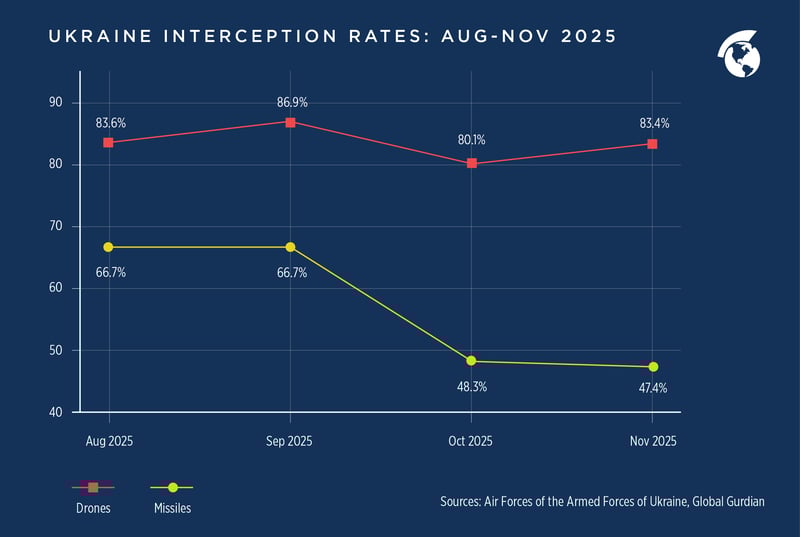
Data also suggests that certain Russian systems—including the Oreshnik ballistic missile—have improved their ability to evade interceptors in the terminal phase of their descent. Since August 2025, Ukraine’s missile interception rate has dropped sharply—from 66.7% to 47.4% in November. Ukraine’s drone interception rate has, however, remained relatively stable in the range of 80-87% month over month. In August 2025, Russia launched 4,146 drones and 159 missiles, of which 678 drones and 53 missiles evaded Ukrainian defenses. In November, Russia launched 5,222 drones and 211 missiles of which 868 drones and 111 missiles made it through.
Looking Forward
The U.S. administration’s most recent attempt at brokering an end to the war has failed to achieve substantial progress, hampered by the irreconcilability of each side's demands. While both Ukraine and Russia are losing significant blood and treasure, Ukraine will not be compelled to cede territory that Russia has been unable to seize, and Russia will not be compelled to end a war it perceives itself to be winning—albeit slowly. For its part, Washington has been trying to reach a settlement as quickly as possible, and has been either unable or unwilling to exercise the long-term strategic commitment to establishing sufficient leverage to effect the end of the conflict.
For Kyiv, and other Ukrainian cities behind the front, the lack of progress diplomatically and the stagnant frontline is highly likely to translate into a significant increase in both the volume of strikes and—barring a dramatic improvement in Ukraine’s air defense situation—strike-related casualties.
Key Takeaways
|

Japan Ends Strategic Ambiguity Over Taiwan
Sino-Japanese tensions are spiking, following a major bilateral diplomatic row. On 07 November, Japanese Prime Minister Sanae Takaichi insinuated that Japan would defend Taiwan militarily if China invaded. Takaichi's comment infuriated Chinese netizens and public officials who have responded with threats, military provocations, diplomatic posturing, and economic sanctions. The East China Sea is emerging as a key regional flashpoint, joining the Taiwan Strait and South China Sea.
- Global Guardian recommends reviewing regional travel itineraries and avoiding booking direct travel from China to Japan in case of flight cancellations.
- We recommend continued monitoring of the regional geopolitical situation.
Situation Report
On 07 November 2025, Japanese Prime Minister Takaichi responded to an opposition question about situations where Japan could be required to exercise “collective self-defense” by saying: "If there are battleships and the use of force, no matter how you think about it, it could constitute a survival-threatening situation." Under Japan’s 2015 Peace and Security Legislation, the Japan Self-Defense Forces (SDF) are permitted to engage in combat operations in acts of collective defense if an attack on a Japanese ally threatens Japan’s survival. A day after making the initial comment, Takaichi clarified that the comments were hypothetical, but she has not walked back the comments.
Since then, China has taken a number of retaliatory steps in the military, economic, cultural and diplomatic domains.
Military
- Increased Chinese Coast Guard (CCG) around the disputed Senkaku/Diaoyu/Diaoyutai. On 02 December, a CCG ship drove away a Japanese fishing boat.
- From 14 November through early December, China deployed over 100 vessels across the Yellow Sea, East China Sea, South China Sea, and West Pacific in what appears to be an unannounced drill.
- On 06 December, Chinese Peoples Liberation Army Air Force fighter jets twice locked their radar on Japanese fighters southeast of Okinawa in the Philippine Sea.
Economic
- Cancellation of ~1,900 flights from China to Japan.
- Issuing of travel advisories to discourage Chinese tour companies from organizing trips to Japan.
- Suspension of Japanese seafood products imports.
- Issuing of threats to restrict access to rare earth minerals.
Cultural
- Chinese film distributors suspended screenings of Japanese films, including "Crayon Shin-chan the Movie" and "Cells at Work!"
- Chinese authorities ordered the cancellation of all Japanese concerts and performances through 2025, and halted permit submissions for 2026.
Diplomatic
- Chinese officials have been appealing to foreign nations and the U.N. to condemn Takaichi’s statement and arguing that Japan is trying to resurrect its early-20th-century empire.
- On 24 November, President Xi Jinping made an unscheduled call to President Donald Trump.
- On 01 December, a Chinese Ministry of Foreign Affairs Spokesperson declared the 1951 San Fransico Agreement—the formal end to WWII in the Pacific—to be illegal and invalid after state-affiliated newspapers question Japan's sovereignty over Okinawa.
ANALYSIS
China is leveraging Prime Minister Takaichi’s comment to further its territorial claims in its near abroad, specifically against Taiwan and Japan in the legal realm. China’s post-colonial framing of the Ryukyu Islands (including Okinawa) and linkage of the Ryukyus to the disputed Senkaku/Diaoyu Islands is an attempt to delegitimize Japan’s—and America’s— presence on the islands east of Taiwan and more importantly, to create a legal claim that serves as a casus beli for future conflict with Japan. In other words, China is attempting to preemptively shape the information space to create a legal pretext to block Japanese intervention in a Taiwan crisis or even to attack Japan.
The Xi-Trump phone call was an attempt to create public daylight between the U.S. and its treaty ally Japan. President Xi recalled the Sino-American partnership in WWII fighting “fascism and militarism,” with militarism being a veiled reference to Japan. It is clear from the United States’ relative silence around Sino-Japanese tensions that maintaining the October U.S.-China trade truce is a very high priority for the Trump administration. To this effect, a report indicated that the U.S. will not issue further export controls on China and has paused plans to sanction its Ministry of State Security (MSS) over its role in the major Salt Typhoon infrastructure hack.
Looking forward
Understanding American reticence towards delivering a full-throated defense of Japan, its posture on Taiwan, and its territorial claims, China is likely to continue to use this as an opportunity to escalate its Grayzone campaign against Japan, raising the bar of what Japan is willing to accept until China faces real pushback from either Japan or the U.S. As a result, the stage is set for a military accident or miscommunication that can trigger an acute crisis in the air or at sea.
In line with historical precedent, China is likely to take further economically punitive measures against Japan, barring a Japanese rhetorical or strategic concession.
- In 2010, following a collision between a Chinese fishing boat and two Japanese Coast Guard vessels near the disputed Senkaku/Diaoyu Islands, Japan arrested the Chinese captain. China retaliated by imposing an unofficial embargo on rare earth exports to Japan and detaining four Japanese businessmen.
- In 2016, following South Korea's approval of the deployment of the U.S. THAAD missile defense system to South Korea, China instituted a group tour travel boycott of South Korea and restrictions on South Korean cultural imports, including certain cosmetics, K-pop concerts, and entertainment content.
- In 2020, following Australia's call for an independent inquiry into the origins of COVID-19, China enacted trade barriers on Australian wine and barley imports.
Key Takeaways
|
CUSTOM INTELLIGENCE
Our intelligence analysts provide in-depth custom reports—including critical insight from on-the-ground resources—for clients and organizations in need of real-time analysis of world events with the potential to impact business operations. To learn more—and start building your report—complete the form below.