


VENEZUELA
In Global Guardian's monthly Risk Barometer, our Intelligence Team highlights current global hotspots with the potential to impact your business operations and travel. Read below for analysis on the threats we are closely monitoring this month and click here to subscribe for regular intelligence updates.

Investors Warm on Venezuela, But Political Stability Is Conditional
After months of apprehension, investors are entering Venezuela. However, Venezuela saw a 181% year-over-year increase in demonstrations in the first half of 2026. Venezuela’s slow progress on democratic transition amid a flurry of resource concessions threatens to increase risk of civil unrest in the short to near term as the Venezuelan people grow impatient over the promised democratic transition, release of political prisoners, and free elections.
Recommendations
- Global Guardian advises firms with personnel or assets tied to Venezuela's energy sector to monitor Caracas-area demonstrations closely. Protests at government and security installations have remained contained but could scale if political transition continues to appear distant.
- Firms operating in Venezuela should develop contingency plans for large-scale unrest or prolonged demonstrations.
Situation Report
Following months of stability under Interim President Delcy Rodríguez and close U.S.–Venezuela collaboration ranging from legislative reform to security, a series of concessions and contracts were signed with private energy firms. Between April and August 2026, Chevron, Hunt Oil, Crossover Energy, BP, XRG, UCC, Shell, Eni, and Repsol each signed or expanded concession and production agreements with Venezuela’s state-owned oil and gas company, PDVSA.
On 28 August, U.S. President Trump announced the North American Blue Energy Partners (NABEP) deal: 100-year concessions across 17 fields holding roughly 65 billion barrels—about a fifth of Venezuela's proven reserves—alongside a 35% U.S. equity stake at no taxpayer cost, guaranteed low-cost offtake rights, board veto power, and U.S. legal jurisdiction. The administration framed the arrangement as securing U.S. energy supply, displacing prior Russian and Chinese involvement, and funding Venezuelan reconstruction through an estimated $209 billion in projected tax and royalty payments to Caracas.
Meanwhile, Venezuela has seen an increase in protest activity, as U.S. promises of a democratic transition and an end to repressive policies have emboldened the Venezuelan people. The Venezuelan Observatory of Social Conflict, a Venezuelan NGO focused on studying social conflict, counted 3,495 protests in the first six months of 2026, a 181% increase compared to the same period in 2025. Most of these demonstrations were related to the right to political participation, including demands for democratic transition, the release of political prisoners, and free elections. These demonstrations have so far generally been small-scale and peaceful, such as on 09 June, when several hundred opposition protesters marched in Caracas, demanding the promised release of political prisoners and free and transparent elections.
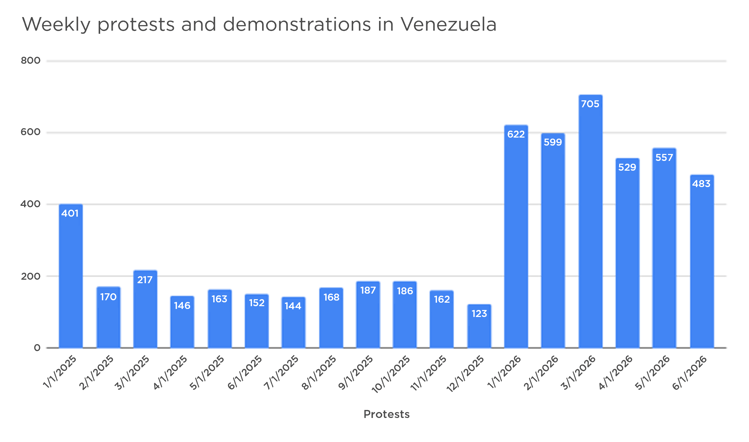
Source: Conflictividad social en Venezuela durante el primer semestre de 2026, 2025
Context
On 03 January 2026, U.S. forces captured and arrested Venezuelan leader Nicolás Maduro and his wife Cilia Flores, taking them to New York City to face federal charges including narco-terrorism conspiracy and cocaine trafficking. Delcy Rodríguez, Maduro’s former vice president, was installed as interim president. Immediately after the Maduro raid, U.S. President Trump referenced the role of U.S. oil firms in exploiting Venezuelan oil as a tool to increase U.S. energy supply and rebuild Venezuela, a sharp contrast to Secretary of State Marco Rubio's rhetoric, which focused overwhelmingly on democratic transition. On 09 January, in a comment representative of investor caution at the time, ExxonMobil CEO Darren Woods told a White House roundtable with oil executives that Venezuela remained "uninvestable" without durable legal protections.
Venezuela's government moved quickly to remove the legal barriers investors had cited. On 29 January, the National Assembly passed the most significant reform to the Organic Law on Hydrocarbons since 1976, capping royalties up to 30%, introducing a 15%-capped Integrated Hydrocarbons Tax, and opening disputes to international arbitration for the first time. The same day, the U.S. Treasury Department Office of Foreign Assets Control (OFAC) issued General License 46, authorizing established U.S. firms to resume commercial activity involving Venezuelan-origin oil. Over the following weeks, Energy Secretary Chris Wright and Interior Secretary Doug Burgum separately visited Caracas, where Rodríguez pledged security guarantees to energy and mining investors. In March 2026, the U.S. Embassy was reopened, further signaling close cooperation and amicability between the U.S. and the Rodríguez administration.
Analysis
The NABEP deal was likely intended to provide confidence to private investors who would now share a stake in Venezuela’s future with the U.S. government. However, the deal is controversial in the U.S. and Venezuela alike. The Pentagon's 35% equity stake through the Office of Strategic Capital likely violates Venezuela's 1999 Constitution, which bars leasing national territory to a foreign state. In addition, NABEP owner Alejandro Betancourt, who built his wealth through Chávez-era government contracts, faces active money-laundering investigations in Spain and Switzerland.
The NABEP agreement risks being perceived as showing that U.S. intentions are solely focused on securing natural resources, sidelining elections and democratic transition. This comes as popular discontent with the Rodríguez administration has been building for months. Compounded by the delayed transition process, an earthquake response viewed as slow and inadequate, and association with the Maduro regime, Rodríguez's approval rating has fallen to 19% as of July 2026, down from 37% approval when she took office in January. The same pollster similarly found that the share of Venezuelans who rate the government as “bad or very bad" rose from 33.5% in February 2026 to 58% in July.
LOOKING FORWARD
The NABEP deal showcases that Secretary Rubio's democracy-first vision has been sidelined in favor of President Trump's resource-first approach. Trump's direction for Venezuela prioritizes securing natural resources through partnership with interim President Delcy Rodríguez, at the expense of the elections and political-prisoner releases opposition supporters were promised. Delaying Venezuela’s democratic transition is increasing popular discontent and increasing the risk of major unrest in the coming months.
Key Takeaways
|
CUSTOM INTELLIGENCE
Our intelligence analysts provide in-depth custom reports—including critical insight from on-the-ground resources—for clients and organizations in need of real-time analysis of world events with the potential to impact business operations. To learn more—and start building your report—complete the form below.